Real Estate Data Is Always Behind the Market
The swings in today’s market are sharper and more volatile than most people realize. When mortgage rates dip, buyer activity disproportionately accelerates almost immediately. When financial markets have bad weeks or negative headlines dominate the news cycle, buyers pull back just as fast. In a region like ours, where so much of the economy is tied to government and policy shifts, that volatility is amplified. If you are not paying close attention to where we are in the cycle, it is very easy to misread the moment and make the wrong move.
Most of the sales numbers being discussed right now reflect activity that happened 60 to 90 days ago. Homes that “sold” in January were typically negotiated and ratified back in November and December, which was a completely different market environment than what we’re seeing today.
That lag has always existed. But today, it matters more than ever because buyer behavior has become incredibly sensitive to rates, headlines, and sentiment.
If you’ve been paying attention to the housing news lately, you’ve probably seen a wave of bearish headlines. The leading narrative right now is that home sales are collapsing. CNBC called it "A New Housing Crisis." The idea is homes sales are collapsing as a result of waning demand or an overall market downturn finally coming to fruition.
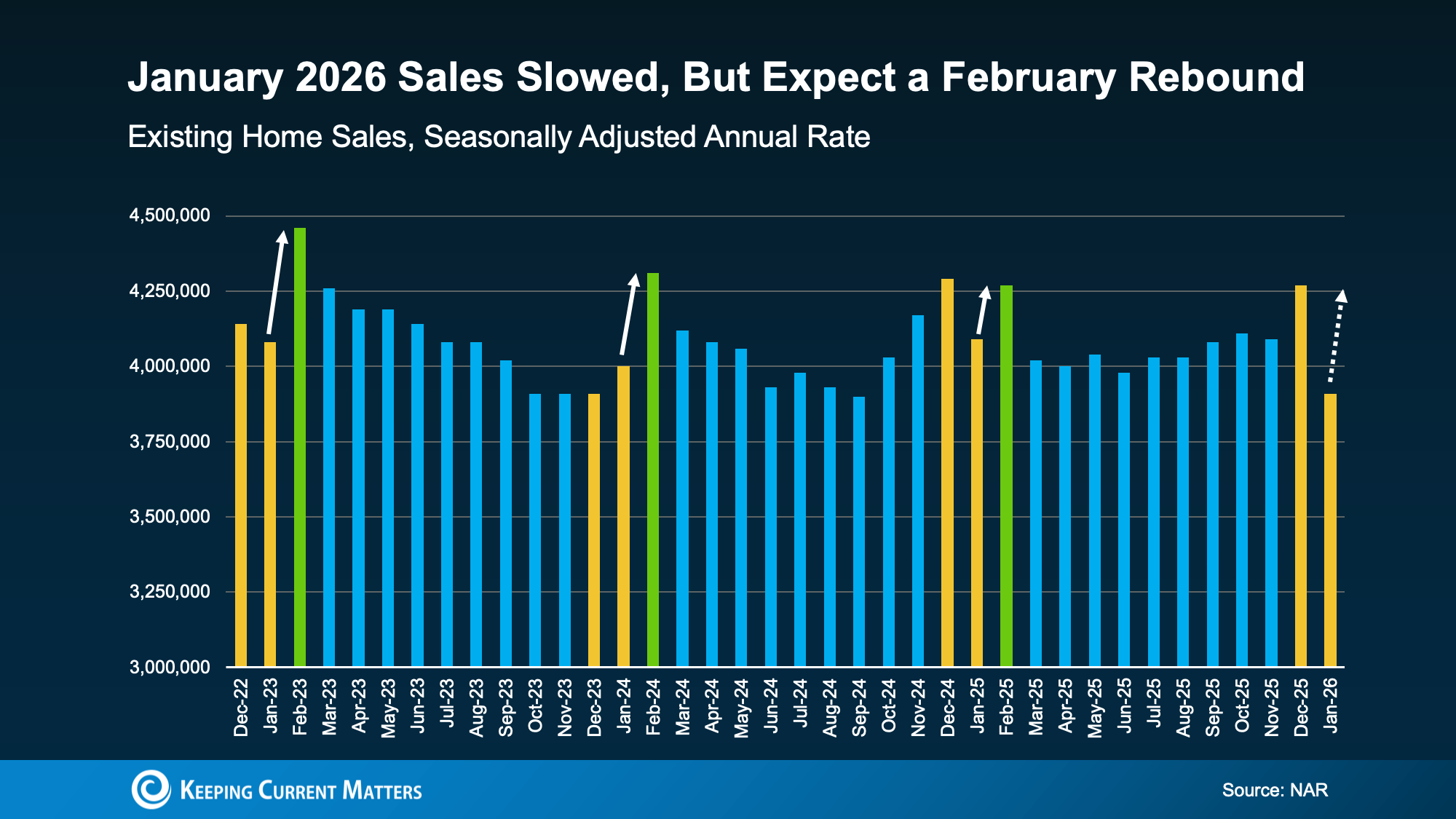
January saw a “record” 8.1% drop in home sales from the previous month. That sounds dramatic, but it ignores a basic reality. January is almost always one of the slowest months of the year. Sales fall after the holidays every year. While this January posted an 8% decline, the long term average is closer to a 4 to 5% drop.
I predicted this would happen because of the government shutdown in Q4 last year, which effectively froze large portions of our market and others tied to federal employment and contracting. Sales in January are a direct reflection of that market.
The data, and what I am seeing on the ground, suggests that the additional 3 to 4% decline beyond the normal seasonal drop is not permanent. Those sales are not gone. They were pushed out and are now working their way back into the market. This chart illustrates this pattern well:
Mortgage Rates at Four Year Low
Almost overnight, we are seeing a new wave of attention because mortgage rates have fallen to four year lows. Thirty year fixed rates are back under 6 percent, only the second time this has happened since 2022. The first time was earlier this year, and many buyers overreacted because the last time they were seriously paying attention, likely in the spring of 2025, rates were meaningfully higher.
While buyers will eventually become more accustomed to these rate levels and the reaction will become more muted, lower rates should still provide a real boost for sellers heading into the spring market.
This could be especially significant given that the last four weeks of slower than expected sales, largely driven by weather, has likely created additional pent up demand. Even if inventory improves this year, the strongest segments of our market are still nowhere near where they need to be in terms of quality homes to meet that demand.
What Happens Next: Bad Headlines Now, Good Headlines Later
Here is what I expect over the next few weeks as the headlines begin to catch up with reality. As the homes that went under contract in January start to close, typically 30 to 60 days later, the tone is going to shift. The data should show stronger pricing, shorter days on market, and a pickup in overall activity.
We may still see another softer than expected month over month number for total sales because of January’s weather disruption, but prices are likely to increase more than expected given that the limited inventory that did sell, sold above expectations. The same market that was recently described as “crashing” will suddenly be labeled resilient or rebounding.
The Real Danger: Misreading the Moment
This lag between real-time market behavior and reported data is one of the biggest reasons buyers and sellers make costly mistakes. I see it constantly and it happens because buyers & sellers are active participants only for a moment in time, and frankly the same can be said about most Realtors that lack the experience or sales volume necessary to make better judgement calls.
A single-family home in Fairfax County is not the same market as a luxury townhouse in Loudoun. A spec home in Vienna is not the same market as a started home in Arlington. Even two homes in the same neighborhood can behave differently depending on price point, condition, and buyer profile. Real estate has become more fragmented and more volatile than it has ever been. Unfortunately, many agents don’t do enough volume to understand where we are in the cycle at any given moment. They take one experience, apply it broadly, and then reinforce it with the same headlines their clients are reading. Being on the opposite side, or at least doing enough volume to recognize.
How to Evaluate the Market
The market today is best measured by what’s happening in real time:
How many active listings are there relative to under contract listings.
How many showings listings are getting.
How quickly homes are going under contract.
How many price reductions are happening.
How competitive offers are becoming.
That’s the market. It’s what’s happening with current active inventory, what is going under contract right now, and the most relevant recent sales. Everything else is delayed commentary. It can be useful and it should be scrutinized, but real time data matters more than anything when you are making decisions in this environment.
Final Thought
I suspect we are going to see a wave of overpriced listings this spring, driven by sellers and agents overreacting to a data set of sales that were bid up in unusually competitive situations 30-60 days earlier. Many of those listings will sit, not because the market is weak, but because the pricing is based on the wrong moment in time.
We will also see buyers encouraged to take on too much risk and overpay simply because that is what agents saw happen six weeks earlier, in a different segment of the market, under different conditions. Let this post serve as a warning. Pay attention, stay grounded, and be cautious.
The 2026 market may prove to be one of the most complicated and nuanced environments we have seen in years. Are we on the verge of an economic boom, or are we heading into a period of disruption where AI reshapes entire industries and job markets? Will proximity to Metro and office corridors matter as much in the future, or will self driving transportation change everything about how people live and commute?
No one knows. But that uncertainty is exactly why understanding real time market conditions matters more than ever.

Learn about buyer rebates and reduced-cost listing options
Khalil El-Ghoul is a seasoned real estate broker actively helping sellers and buyers throughout Northern Virginia, DC, and Maryland. Known for his no-nonsense approach, Khalil combines expert market insight with honest, objective advice to help buyers and sellers navigate every type of market—from calm to chaotic. If you’re looking for clarity, strategy, and a trusted partner in real estate, he’s the one to call.

Subscribe Now
Learn the ins and outs of real estate and tips for a sales-ready home - straight to your inbox.
Follow Us